

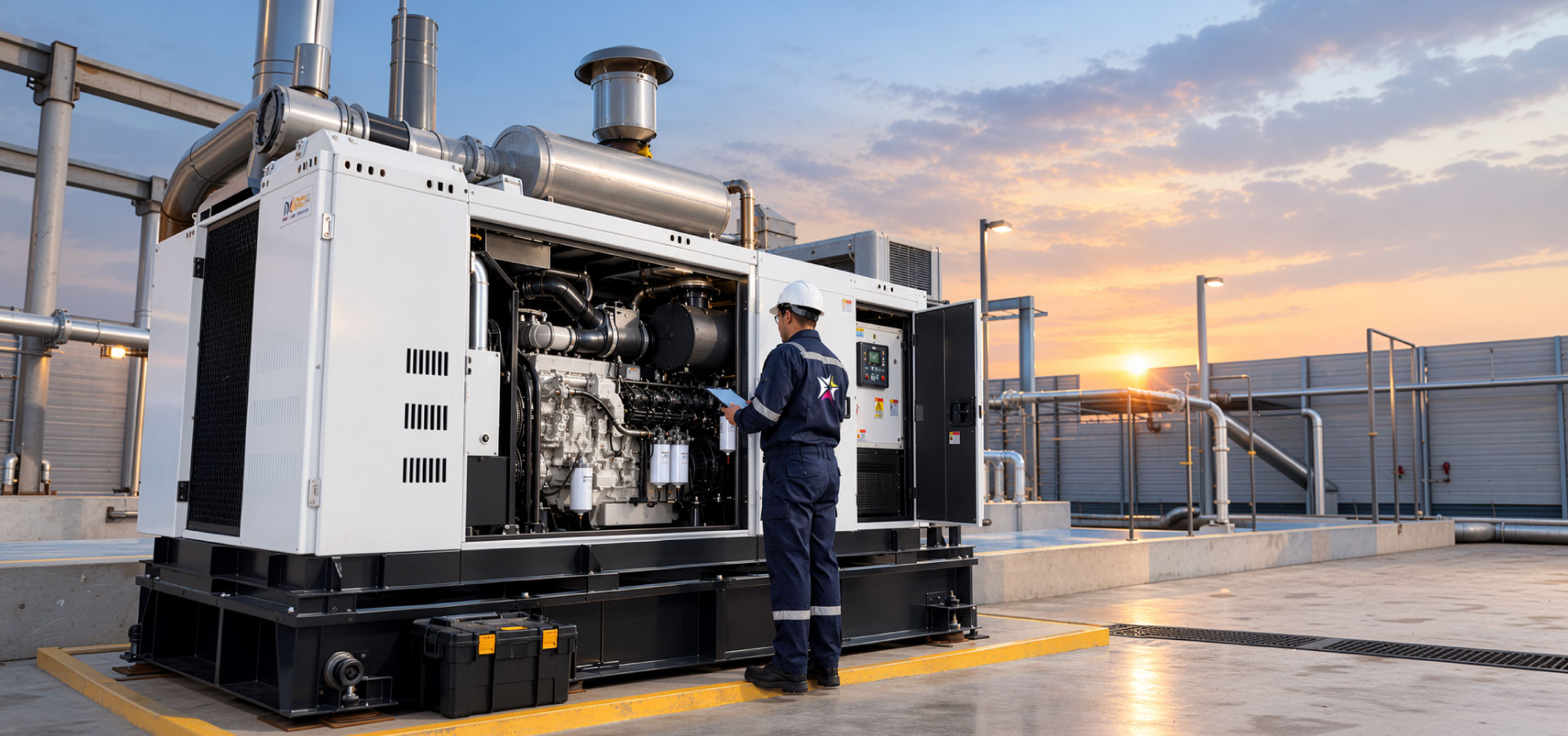
Keeping the Power On: Why Generator Maintenance Is Your Facility's Ultimate Insurance Policy
When the electrical grid fails, the clock starts ticking immediately1. Across commercial developments, hospitals, data centers, and manufacturing plants, standby generators carry a single, critical expectation: start automatically, stabilize, and assume the entire facility’s electrical burden within ten seconds1.
Yet, because backup generators spend the majority of their lifespans sitting idle, they are often forgotten until a blackout strikes3. When maintenance is neglected, generator reliability drops precipitously, failing to perform when needed most5. An unexpected power failure during an outage brings operations to an abrupt halt, risking costly operational downtime, spoiled inventory, compliance violations, and severe safety hazards1.
Keeping backup power assets ready is not about complex laboratory science; it is about building a disciplined, straightforward maintenance routine1. Here is how facility managers can eliminate the most common failure points, optimize service budgets, and ensure their generators run reliably for decades1.
The Hidden Culprits Behind Generator Failures
Most people assume a generator failure involves a catastrophic engine seizure1. In reality, field experience shows that engines rarely break down mechanically on their own1. Instead, outages are almost always caused by auxiliary support systems that quietly deteriorate while the unit is on standby1:
● Dead Starter Batteries (80% of Starting Failures): The single most frequent reason a generator fails to turn on is a dead or degraded battery1. Over months of sitting in a warm enclosure on a continuous float charger, batteries quietly lose their internal cranking power8. A standard voltmeter might show normal voltage at rest, but the moment the starter motor demands high electrical current, a weakened battery collapses instantly8.
● Contaminated and Stale Diesel: Unlike standard vehicle fuel that gets burned within days, generator diesel sits in storage tanks for months or years11. Day-to-night temperature changes cause condensation to form inside the tank9. This pool of moisture becomes a breeding ground for bacteria and fungal algae9. Once the generator starts and draws high fuel flow, this thick bio-sludge clogs the fuel filters within minutes, starving the engine of fuel9.
● The “Wet Stacking” Trap: Running a diesel generator for short exercise periods without a proper electrical load does more harm than good1. Without adequate load—ideally at least 30% of its rated capacity—the engine never reaches proper operating temperature1. Unburned fuel and soot escape into the exhaust system, creating a sticky black sludge that gums up turbochargers, coats exhaust risers, and glazes the cylinder walls2. Over time, this leads to permanent power loss and elevated fire hazards8.
The Maintenance Ladder: A Simple Routine for Maximum Uptime
A dependable generator maintenance plan follows a predictable schedule of visual checks, functional exercise runs, and deep servicing1:
1. The Weekly Walkaround
A five-minute weekly inspection catches small issues before they become emergencies1. Operators should ensure the master control panel is set to “AUTO,” check for fluid leaks under the engine skid, confirm that jacket water heaters (block heaters) are keeping the engine warm, and ensure cooling air louvers are clear of dust and debris1.
2. The Monthly Test Run
Under safety standards like NFPA 110, emergency generators should be exercised under building load for at least 30 minutes every month1. This exercise run confirms that the automatic transfer switch (ATS) detects the power loss, cranks the engine, and transfers building power seamlessly1. Running under adequate load warms the engine, charges the batteries, and burns off harmful soot deposits1. Technicians should also drain any accumulated water from fuel-water separators during this run1.
3. The Annual Deep Service
Once a year, the generator should receive a full mechanical refresh1. This includes renewing engine oil and filters, replacing fuel and air filter elements, checking coolant corrosion inhibitors, and sampling the fuel tank for water and sludge1. If monthly test runs cannot achieve a 30% load, an annual load bank test—connecting the generator to an external portable electrical resistor—is necessary to cleanly burn off carbon deposits and stress-test the cooling system1.
4. The 2-to-3-Year Battery Rule
Starting batteries should be proactively replaced every 24 to 36 months, regardless of whether they appear functional8. Waiting for a battery to fail before replacing it is the most common reason facilities find themselves left in the dark1.
Preventive vs. Emergency Maintenance: Understanding the Economics
Treating a generator with a “fix-it-when-it-breaks” mentality is the most expensive way to manage a facility4. Unplanned emergency repairs cost three to five times more than scheduled preventive maintenance7.
Industry data confirms that every $1 invested in routine generator maintenance saves between $4 and $10 in avoided emergency technician callouts, expedited air freight for spare parts, expensive temporary rental generators, and business interruption4.
Scheduled Preventive Maintenance vs. Unplanned Emergency Repairs
Repair Cost Impact Scheduled preventive maintenance follows a baseline cost planned within the operating budget, while emergency repairs can be 3x to 5x more expensive due to emergency callout rates.
Business Downtime Preventive maintenance is completed during off-peak hours with minimal to zero disruption. Emergency repairs, on the other hand, often occur during high-stress outages, including utility blackouts.
Damage Scope Preventive maintenance identifies and resolves minor issues early before they escalate. With reactive maintenance, small faults can trigger cascading failures across the engine.
Facility Budget Ratio Well-run maintenance programs typically allocate 1% to 3% of equipment value annually, compared with 4% to 6% spent by reactive sites on recurring crisis repairs.
Equipment Longevity With proper preventive maintenance, assets can reach 30,000+ operating hours. Reactive maintenance increases the risk of premature engine failure and early asset replacement.
Consider the practical difference: during routine maintenance, an oil sample acts like a blood test for the engine, identifying worn bearing metal while parts cost very little18. If ignored, that same bearing eventually wears down to bare steel, seizes, and throws a connecting rod straight through the engine block—turning a simple planned repair into a complete engine replacement costing upwards of $150,00017.
Demystifying Overhauls: Top-End vs. Major Rebuilds
For generators supporting prime-power microgrids, peak-shaving operations, or facilities with high operating run-times, periodic overhauls are essential to restore engine efficiency and factory clearances3. Rather than tracking hours alone, experienced engineers monitor total fuel consumed, which accurately reflects the actual mechanical work and thermal stress the engine has handled over time22.
Overhauls generally fall into two distinct categories:
Top-End Overhaul (Mid-Life Refresh)
● When: Typically between 6,000 and 12,000 operating hours10.
● How It’s Done: This work is performed “in-frame,” meaning the engine stays mounted to its structural skid and remains attached to the electrical alternator20.
● The Scope: Technicians remove and rebuild the cylinder heads, replace intake and exhaust valves, install new valve guides and seals, inspect turbochargers, and recalibrate fuel injectors20.
● The Result: It restores compression, cleans up fuel spray patterns, eliminates exhaust blow-by, and adds another 8,000 to 12,000 hours of operating life at a fraction of the cost of a new engine20.
Major Overhaul (Zero-Hour Rebuild)
● When: Typically between 15,000 and 30,000+ operating hours3.
● How It’s Done: This is a comprehensive rebuild where the engine is uncoupled from the alternator and lifted out of its frame24.
● The Scope: The entire engine is stripped down to the bare block24. Technicians install new cylinder liners, pistons, wrist pins, and piston rings17. The crankshaft is inspected, polished, and fitted with fresh main and connecting rod bearings, while oil and water circulation pumps are renewed17.
● The Result: A major overhaul completely resets the engine back to zero operating hours24. High-quality industrial engine blocks can undergo up to three complete rebuilds, allowing a single engine to deliver over 100,000 hours of reliable lifetime service24.
Making Reliability Routine
A standby generator should never be an unpredictable variable during an operational crisis4. By implementing a simple, proactive routine—testing starter batteries, keeping stored fuel clean, exercising engines under proper load, and planning overhauls around real operational wear—facility leaders protect their balance sheets and guarantee continuous power when it matters most1.
At Al Aman our Operation & Maintenance (O&M) division brings more than two decades of dedicated electromechanical and power-generation expertise to protect your critical power infrastructure. From routine compliance inspections, fluid condition monitoring, and load testing to precision in-frame top-end overhauls and complete zero hour major rebuilds, our certified engineering teams deliver turnkey lifecycle support for prime and standby diesel generators across the Kingdom. Backed by our specialized local manufacturing facilities, dedicated supply chain for genuine replacement parts, and 24/7 rapid technical response, we ensure your power assets maintain peak operational efficiency, preserve long-term capital value, and deliver seamless, dependable electricity whenever the grid goes down.
Other News
News
New Line of Durable Steel Enclosures
Al Aman is proud to announce the launch of its latest range of high-quality steel enclosures
August, 2025
News
Saudi Arabia's Construction Boom Hits 2026 Peak in March
Saudi Arabia’s contracting market delivered its strongest performance of 2026 in March
April, 2026
News
Al Aman Launches New Website
Al Aman is proud to announce the launch of its newly designed website, marking an important step in the company’s commitment to innovation and customer service.
August, 2025