
August 27, 2026
Saudi Arabia’s Renewable Energy Boom Is Creating New Opportunities for Grid Solutions.
What the delivery gap between Vision 2030’s targets and grid reality means for industrial power planning
Saudi Arabia’s renewable energy program is one of the most ambitious infrastructure undertakings in the region’s history. Under Vision 2030 and the Saudi Green Initiative, the Kingdom has committed to sourcing 50% of its electricity from renewables by 2030, backed by an official installed capacity target of roughly 130 GW. The institutional machinery behind this — the Ministry of Energy, the Saudi Power Procurement Company (SPPC), the Public Investment Fund (PIF), and ACWA Power — has already pushed tendered capacity past 64 GW, with signed Power Purchase Agreements exceeding 38–47 GW.
The headline numbers are impressive. The delivery numbers tell a more complicated story — and it’s the story that matters for anyone responsible for keeping industrial and commercial operations powered in the Kingdom over the next four years.
The Math Behind the Target
As of early 2026, Saudi Arabia’s grid-connected renewable capacity stands at approximately 12–13 GW. To reach 130 GW by the end of 2030, the Kingdom needs to commission more than 23 GW of new grid-connected capacity every single year between now and then.
Actual delivery has not kept pace with that requirement. Annual additions ran in the low single digits through 2024 before accelerating to an estimated 5–6 GW in 2025 — a meaningful improvement, but still roughly a quarter of the run-rate the 2030 target demands. Independent analysts project operational capacity landing somewhere between 45 and 74 GW by 2030 — well short of the official target, even under optimistic scenarios.
Why the Grid, Not the Panels, Is the Constraint
The shortfall isn’t primarily about solar or wind project readiness. Saudi Arabia has some of the lowest solar and wind tariffs in the world, and successive NREP tendering rounds have consistently broken global cost records. The bottleneck sits downstream, in the infrastructure that gets generated power onto the grid, balances it, and moves it to load centers:
- Substation equipment lead times. Global lead times for high-voltage transformers and gas-insulated switchgear currently run 3–4 years, creating interconnection delays even on projects where the generation asset itself is complete.
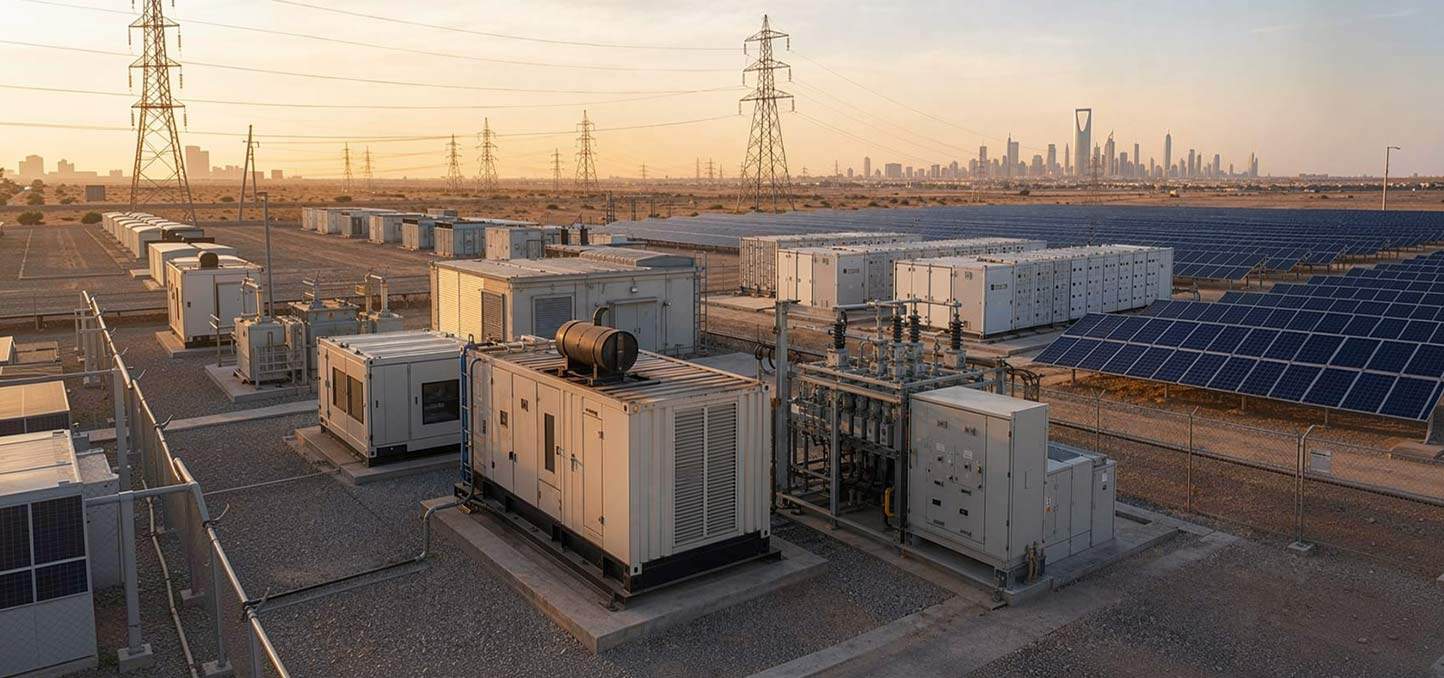
- Grid balancing at scale. Large solar and wind sites now pair with utility-scale battery storage — including a 2 GW / 7.8 GWh standalone system synchronized in late 2025 — and automated SCADA control for real-time frequency regulation. Standing up that layer, including BESS integration, takes time even after generation is ready.
- Transmission and local content. Moving power to Riyadh, the western corridor, and the Eastern Province requires ongoing high-voltage transmission expansion, while local content mandates — 33–35% today, rising to 40–45% after 2028 — push developers toward domestic manufacturing that is still scaling up.
The Kingdom’s Own Backstop: A Signal Worth Reading
Saudi Arabia’s energy planners are not treating this as a hypothetical risk. In parallel with the renewable program, the Kingdom is deploying 42 GW of new combined-cycle gas turbine (CCGT) capacity, engineered to be carbon-capture ready, specifically to backfill domestic demand growth if renewable commissioning slips. That’s a deliberate hedge, built into national energy planning, against exactly the delivery gap the numbers above describe.
For facility operators, contractors, and industrial developers, that same gap plays out at project level rather than national level — but the mechanics are the same. A site can be renewable-ready and still be waiting on grid interconnection. A new industrial facility can have its generation mix finalized on paper and still face years of queue time before that power reaches the meter. In both cases, the operational risk isn’t the transition itself — it’s the timing mismatch between when power is promised and when it’s delivered.
Where ALAMAN Fits in the Delivery Chain
Closing this gap takes more than generation capacity — it takes the engineering work that gets a project from PPA to grid-connected, and the standby capacity that covers the distance in between. At Al Aman Modern Energy Co. (ALAMAN), we work both sides of that chain:
- Solar, BESS & grid-interconnection engineering. Grid impact and interconnection studies, owner’s engineering and quality assurance through construction, battery energy storage system (BESS) integration for peak-shifting and frequency regulation, and local content optimization — sourcing locally manufactured mounting structures, cables, and transformers to meet LCGPA requirements without sacrificing yield.
- Standby and bridging power. Generator enclosures and CKD assembly built for the interconnection wait — reliable, deployable power for operations that need continuity now, not when the grid queue clears.
- In hybrid generation facilities and commercial-industrial microgrids, specialized electrical synchronization panels such as those manufactured by Al Aman Modern Factory are utilized to coordinate and synchronize fluctuating renewable solar power with conventional generators and the national grid. These panels handle automatic load sharing, voltage matching, and phase synchronization to prevent power disruptions and maintain system stability during source switching.
This is precisely the environment in which standby power and disciplined project engineering shift from contingency line items to core infrastructure planning — not as substitutes for the renewable transition, but as the mechanisms that keep operations and projects moving through it.
Saudi Arabia’s clean energy transition is real, well-funded, and structurally sound. The gap between the 2030 target and current grid delivery is equally real. Industrial power planning in the Kingdom over the next several years means accounting for both — and ALAMAN is built to work in that gap.
-
The 5 Biggest Projects in Jeddah Right NowJune 12, 2026
-
Power, Cooling, and Heat from One Fuel Source: How Tri-Generation is Reshaping Saudi Arabia's Energy FutureJuly 01, 2026
-
Saudi Arabia's Construction Boom Hits 2026 Peak in MarchApril 13, 2026
-
Al Aman Company Moves to Al AziziyahSeptember 27, 2025
-
Al Aman at Jeddah Construct 2025September 28, 2025
-
Powering Up SEC Turaif SiteAugust 17, 2025
-
New Line of Durable Steel EnclosuresAugust 15, 2025
-
Al Aman Launches New WebsiteAugust 14, 2025
-
The 5 Biggest Projects in Jeddah Right NowJune 12, 2026
-
Power, Cooling, and Heat from One Fuel Source: How Tri-Generation is Reshaping Saudi Arabia's Energy FutureJuly 01, 2026
-
Saudi Arabia's Construction Boom Hits 2026 Peak in MarchApril 13, 2026
-
Al Aman Company Moves to Al AziziyahSeptember 27, 2025
-
Al Aman at Jeddah Construct 2025September 28, 2025
-
Powering Up SEC Turaif SiteAugust 17, 2025
-
New Line of Durable Steel EnclosuresAugust 15, 2025
-
Al Aman Launches New WebsiteAugust 14, 2025
-
The 5 Biggest Projects in Jeddah Right NowJune 12, 2026
-
Power, Cooling, and Heat from One Fuel Source: How Tri-Generation is Reshaping Saudi Arabia's Energy FutureJuly 01, 2026
-
Saudi Arabia's Construction Boom Hits 2026 Peak in MarchApril 13, 2026
-
Al Aman Company Moves to Al AziziyahSeptember 27, 2025
-
Al Aman at Jeddah Construct 2025September 28, 2025
-
Powering Up SEC Turaif SiteAugust 17, 2025
-
New Line of Durable Steel EnclosuresAugust 15, 2025
-
Al Aman Launches New WebsiteAugust 14, 2025
-
The 5 Biggest Projects in Jeddah Right NowJune 12, 2026
-
Power, Cooling, and Heat from One Fuel Source: How Tri-Generation is Reshaping Saudi Arabia's Energy FutureJuly 01, 2026
-
Saudi Arabia's Construction Boom Hits 2026 Peak in MarchApril 13, 2026
-
Al Aman Company Moves to Al AziziyahSeptember 27, 2025
-
Al Aman at Jeddah Construct 2025September 28, 2025
-
Powering Up SEC Turaif SiteAugust 17, 2025
-
New Line of Durable Steel EnclosuresAugust 15, 2025
-
Al Aman Launches New WebsiteAugust 14, 2025
-
The 5 Biggest Projects in Jeddah Right NowJune 12, 2026
-
Power, Cooling, and Heat from One Fuel Source: How Tri-Generation is Reshaping Saudi Arabia's Energy FutureJuly 01, 2026
-
Saudi Arabia's Construction Boom Hits 2026 Peak in MarchApril 13, 2026
-
Al Aman Company Moves to Al AziziyahSeptember 27, 2025
-
Al Aman at Jeddah Construct 2025September 28, 2025
-
Powering Up SEC Turaif SiteAugust 17, 2025
-
New Line of Durable Steel EnclosuresAugust 15, 2025
-
Al Aman Launches New WebsiteAugust 14, 2025