

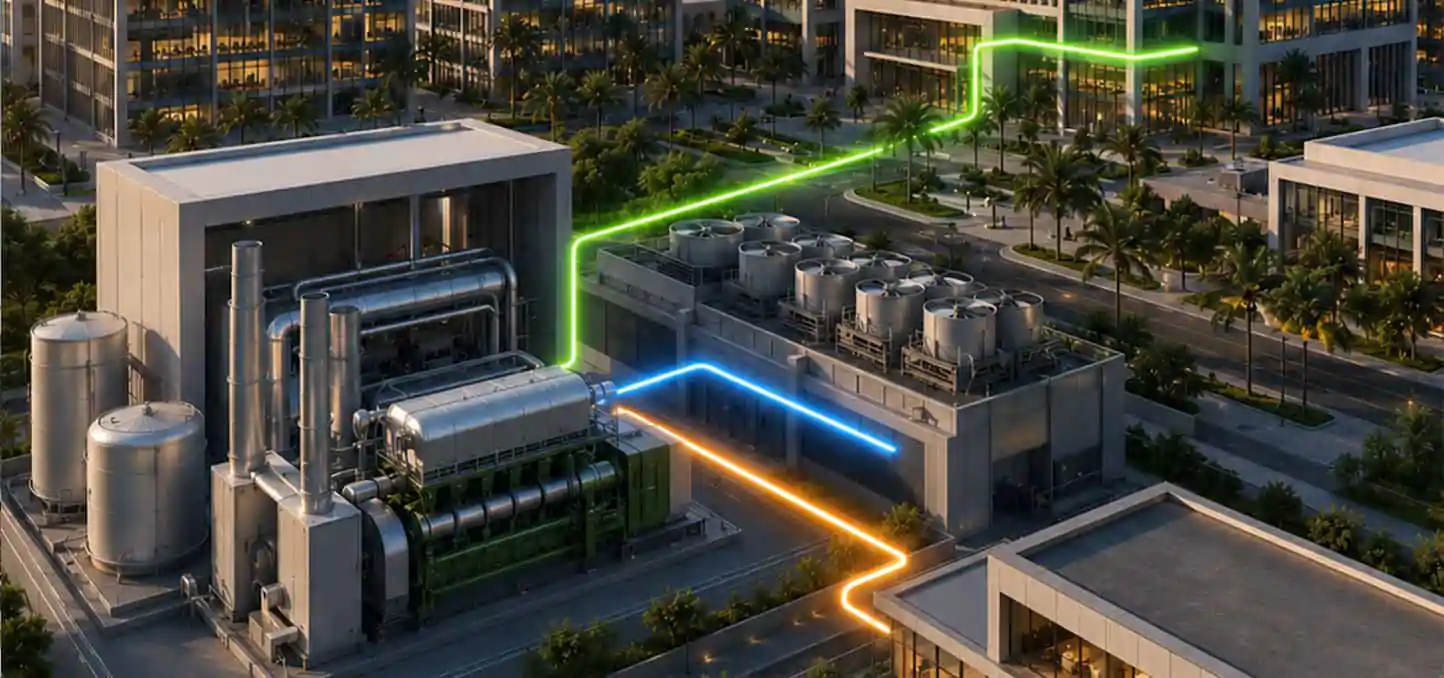
Power, Cooling, and Heat from One Fuel Source: How Tri-Generation is Reshaping Saudi Arabia's Energy Future
Every conventional power plant in the world has an expensive, invisible secret: it throws nearly two-thirds of its fuel’s energy straight up the chimney as wasted heat. You pay for that fuel, but you only get the electricity. The rest vanishes into thin air.
In Saudi Arabia where space cooling is the single largest drain on our electrical grid —that wasted heat is the most costly oversight in our energy budget. Because the very same heat we throw away can be captured and recycled into the exact cooling we are paying a second, expensive utility bill to produce.
This is the simple but revolutionary idea behind Combined Heat and Power (CHP), and its ultimate evolution, tri-generation.
What Actually is CHP?
Think of Combined Heat and Power (CHP) often called “cogeneration” as a highly efficient, single-cycle recycling system.
In a traditional setup, you buy electricity from the grid to power your building, and burn fuel separately in a boiler for heat or steam. This fragmented approach is wasteful, operating at a combined efficiency of only about 50%. CHP changes the game, generating electricity and useful heat simultaneously from a single fuel source:
- Generate electricity: A high-efficiency gas or diesel engine burns fuel to generate power right on-site.
- Recycle the exhaust: Instead of letting the hot exhaust gas escape, a heat-recovery system captures it.
- Deliver the heat: That captured energy is turned into useful hot water or high-pressure steam for heating or industrial processes.
By recycling the heat, a CHP system can push overall efficiency past 80% — and up to around 90% in the best-optimized plants. The same fuel, burned once, doing nearly double the useful work.
Tri-Generation: Turning Waste Heat Into Ice-Cold Water
While heating is vital for industry, Saudi developments run on cooling. Buildings consume around 75% of the Kingdom’s electricity, and air conditioning alone can account for up to 70% of a residential building’s power during the peak of summer. The effect on the grid is dramatic: national peak load can nearly double in the summer months, from roughly 33 GW in winter to over 60 GW between June and September.
This is where tri-generation comes in. It takes the recovered waste heat from the CHP generator and feeds it into an absorption chiller. Unlike a conventional air conditioner, which uses an energy-hungry mechanical compressor, an absorption chiller uses a thermal process driven entirely by recycled heat to produce ice-cold water.
From one single fuel source, you now get three distinct outputs: electricity to power the development, chilled water for highly efficient air conditioning, and hot water or steam for heating, kitchens, laundry, or industrial processes.
This creates a perfect economic shift: when summer heat is at its worst and electricity tariffs spike, the system’s waste heat is captured and put to work to generate the most cooling exactly when you need it most.
Two Ideas That Make It Elegant
The closed-loop water cycle
The system works like a perfectly balanced water wheel. Water is turned into steam or hot water using recycled engine heat, travels to do its work, then is cooled and condensed back into liquid and piped straight back into the plant to start again. Minimal waste, in a closed and sustainable loop.
The giant thermal battery
Demand fluctuates heavy cooling by day, very little at night. Because stopping and starting generators wastes energy, tri-generation plants use large insulated hot- and cold-water storage tanks as physical “thermal batteries”. At night, when demand is low, the plant runs at its efficient peak and “charges” these tanks with chilled water. By day, it “discharges” that stored energy to meet the surge without straining the national grid.
The Service: A Centralized District Energy System (DES)
This technology is delivered as a centralized District Energy System (DES). In a conventional setup, a development scatters hundreds of small AC units, water heaters, gas cylinders and tanks across every rooftop and basement a chaotic network exposed to desert heat and sand, with high maintenance bills and hundreds of potential points of failure. A DES replaces all of that clutter with one centralized Energy Center and a network of insulated underground pipes.
Best of all, the Energy Center is source-agnostic. It can blend fuel, solar, battery storage and the national grid simultaneously, letting operators add new clean-energy sources like solar carports or EV charging points later, without rebuilding the property’s infrastructure.
How It Helps Your Project
Moving away from scattered utility equipment changes the financial and operational landscape of medium-to-large residential, commercial and industrial projects:
- Zero upfront CAPEX: Specialized energy developers design, build, own and operate these networks under long-term BOOT (Build-Own-Operate-Transfer) contracts. Developers avoid massive equipment costs and buy utilities as a single, managed service.
- Lower operating costs: Energy is used more efficiently, maintenance is centralized away from tenant spaces, and tariffs are tailored to actual demand.
- Repurposed space: Rooftops become penthouses, gardens or pool decks — turning structural liabilities into revenue-generating real estate.
- Slower depreciation: Industrial-grade central machinery in a controlled environment degrades far slower than domestic AC units baking on a rooftop.
- Vision 2030 alignment: Consolidated emissions make controls and compliance simpler, directly supporting the Kingdom’s sustainability goals.
Industry Research and Evolving Policy Frameworks
- Global Demand and the Role of District Cooling Strategy& Middle East Report
Under the PwC umbrella, Strategy& Middle East published a major report titled “District Cooling: Regulation Impact,” which highlights that global demand for air conditioning is projected to triple over the next 30 years.
According to Strategy&, centralized district cooling systems consume 20% to 30% less electricity than even the most energy-efficient conventional cooling options, and 60% to 80% less electricity than average systems.
The report states that adopting district cooling for new urban demand in developing countries can reduce peak power capacity requirements by up to 30% and yield over $1 trillion in cumulative energy savings globally through 2035. To unlock these benefits, GCC governments are urged to treat district cooling as a formal utility, incorporating it directly into municipal urban plans and establishing robust technical and pricing codes.
- Escalating Heat Stress (KAPSARC Landmark 2026 Report)
A landmark local research report from the King Abdullah Petroleum Studies and Research Center (KAPSARC), titled “Cooling the Kingdom: Long-Term Impacts of Climate Change on Electricity Demand and Household Expenditure in Saudi Arabia,” projects that climate-induced temperature rises will drive an 80% increase in national cooling service demand across the Kingdom by the year 2100.
Currently, air conditioning is already responsible for 60% to 70% of household electricity consumption in Saudi Arabia and roughly half of the total annual electricity consumed across all buildings. Under severe summer extremes, building peak electricity demand in urban centers can account for up to 75% to 80% of the entire national system load.
- Thermodynamic Benchmarks (US EPA Guidelines)
According to the US Environmental Protection Agency (EPA), generating power and heat separately in traditional setups operates at a combined fuel efficiency of only about 50% to 55%. By capturing and using waste heat on-site and avoiding transmission and distribution losses, modern Combined Heat and Power (CHP) systems consistently achieve overall system efficiencies of 65% to 80%, with highly optimized plants approaching 90% efficiency.
Major Cogeneration & CHP Developers in Saudi Arabia
To bring these complex thermodynamic systems to life, major developers in Saudi Arabia are actively implementing utility-scale cogeneration (CHP) projects across key industrial and urban sectors:
- ENGIE: ENGIE is a leading developer in the Kingdom’s cogeneration space. It fully operates the state-of-the-art, high-efficiency gas-fired Fadhili Cogeneration Plant (commissioned in 2020). Located near Jubail, this plant has a combined cycle capacity of 1,507 MW and produces 1,447 tons of steam per hour to support Saudi Aramco’s gas processing operations. Additionally, ENGIE (in joint venture with Rakiza) operates the Tihama Cogeneration Plants under a 20-year BOOT framework, delivering a combined capacity of 1,600 MW of power and over 2,800 tons of steam per hour to Aramco gas plants across Ras Tanura, Juaymah, Shedgum, and Uthmaniyah.
- ACWA Power & KEPCO: In partnership with the Korea Electric Power Corporation (KEPCO) and the Saudi Electricity Company (SEC), ACWA Power is developing the twin Rumah 1 and Nairyah 1 Combined Cycle Gas Turbine (CCGT) plants. Representing a SAR 15 billion ($4 billion) investment, these projects deliver a combined capacity of 3.6 GW (1,800 MW each). The projects utilize advanced turbines designed to displace oil-fired power generation, significantly cut carbon emissions, and are built to accommodate future carbon capture facilities.
Other News
News
Saudi Arabia's Construction Boom Hits 2026 Peak in March
Saudi Arabia’s contracting market delivered its strongest performance of 2026 in March
April, 2026
News
Al Aman at Jeddah Construct 2025
Al Aman was proud to participate in Jeddah Construct 2025
September, 2025
News
Made in Saudi Arabia: Engineering the Future Locally
August, 2026