

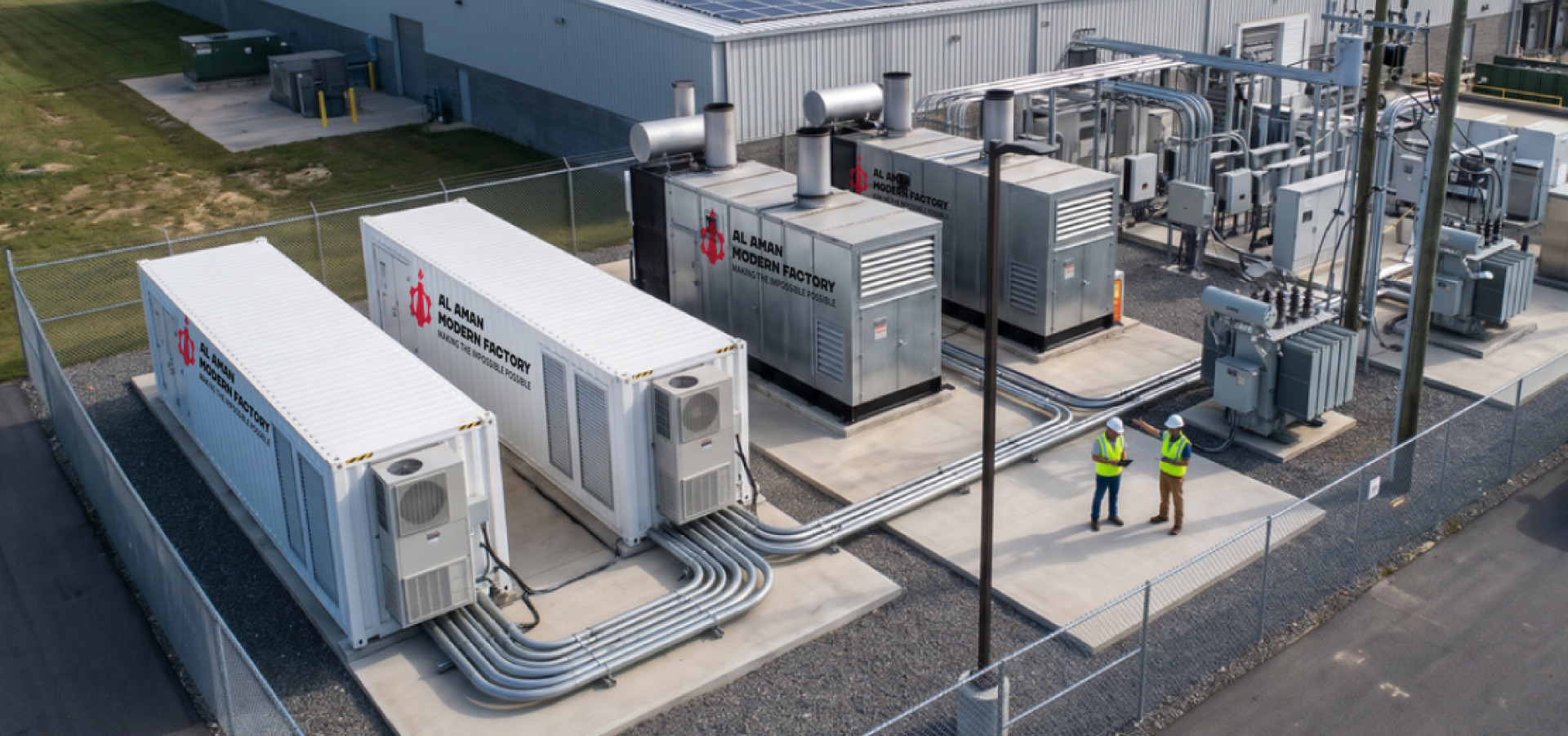
Engineering Reliable Hybrid Power for Saudi Facilities
How solar generation, battery storage, generators and electrical controls can work together to support efficient operation and business continuity.
Solar generation can reduce daytime grid purchases. Keeping essential operations running through a supply interruption requires further decisions: which loads must remain energised, how power sources will change over, and how long the facility must operate independently.
For Saudi industrial plants and commercial developments, a hybrid power system can coordinate solar, battery storage, generators and the utility connection. Its performance depends on how those assets work together under real operating conditions.
Define the loads that must remain operational
Begin with the consequences of losing power. A production line may tolerate a controlled restart, while process controls or communications equipment may require an uninterrupted supply. Cooling and pumping systems can have their own operating limits.
Define essential loads, acceptable interruption times and required operating duration. These determine the equipment and control architecture, reflecting the early planning decisions identified in the US Department of Energy microgrid guidance. [1]
Separating essential loads from those that can be temporarily disconnected makes the backup scope more precise. Specify any requirement for an uninterruptible power supply explicitly.
Give each power source a defined role
Solar generation serves available daytime demand. A battery can absorb surplus production and supply energy later, or retain a reserve for a defined backup duty. Generators can support longer interruptions where the system has suitable fuel provision and operating arrangements. [2, 3]
Agree these roles before selecting equipment. A battery used for daily energy shifting may have less energy available during an outage unless its controller maintains a reserve. Assess generator duty against the expected operating conditions and manufacturer requirements.
Specify the source of supply and operating sequence for normal operation, reduced solar output, utility loss and restoration.
Design the controls and protection together
A hybrid installation needs a coordinated control strategy. Establish which device regulates voltage and frequency during independent operation, how loads are shared, and how the facility disconnects safely from the utility network.
Ordinary grid-connected solar should not be assumed to provide backup power. Continued operation during an outage requires equipment, protection and approvals for the intended islanded mode. Microgrids are designed to operate independently when disconnected from the main grid. [1, 3]
Where sources will operate in parallel, the engineering scope must address synchronisation, load sharing and protection coordination. An energy management controller implements the operating strategy, while SCADA provides supervision, alarms and operating records. Fast protection functions need their own appropriate devices and settings.
Define these interfaces across the inverter, battery, generator and switchgear packages so that suppliers work to a common operating sequence.
Specify battery power and duration separately
Battery power capacity, measured in kW or MW, determines how much load the battery can supply at a given moment. Energy capacity, measured in kWh or MWh, determines how much energy it can deliver over time. A useful specification needs both. [2]
For illustration, supplying a constant 500 kW load for two hours requires 1 MWh of delivered energy. The installed battery capacity would need to account for the usable operating range, system losses, reserve requirements and expected performance over its life.
Also assess starting loads, short-duration peaks and the conditions under which the battery must recharge.
Prove the operating sequence before handover
Commissioning should demonstrate complete system behaviour during utility failure, source transfer, changing demand, low battery reserve and restoration. Where required, test the response to a generator failing to start.
Acceptance criteria should cover transfer times, supported loads, alarms and recovery. Any claim of seamless transfer needs support from the architecture and test results.
Provide the operating team with documentation, training and a maintenance plan covering system interfaces. Retain settings and operating sequences to support future fault investigation.
Build for the installation environment
Heat, dust exposure, ventilation and maintenance access should be considered across the entire installation. Enclosures and equipment rooms must protect equipment while allowing the heat rejection and service access required by the selected products.
For generators, fuel arrangements, cooling and exhaust routing belong in the integrated design. Battery installations require their own siting, environmental control and fire safety assessment in accordance with applicable requirements.
How Al Aman connects engineering and manufacturing
Al Aman Modern Energy offers integrated and hybrid energy solutions and MEP engineering. Al Aman Modern Factory provides panels, switchgear and SCADA systems alongside generator manufacturing and assembly. Our operation and maintenance division supports power plants, energy centres and associated electrical equipment.
Other News
News
Al Aman at Jeddah Construct 2025
Al Aman was proud to participate in Jeddah Construct 2025
September, 2025
News
Al Aman Company Moves to Al Aziziyah
Al Aman Company is pleased to announce its relocation to Al Aziziyah District, Saudi Arabia.
September, 2025
News
The 5 Biggest Projects in Jeddah Right Now
Jeddah is the most active construction market in Saudi Arabia right now.
June, 2026